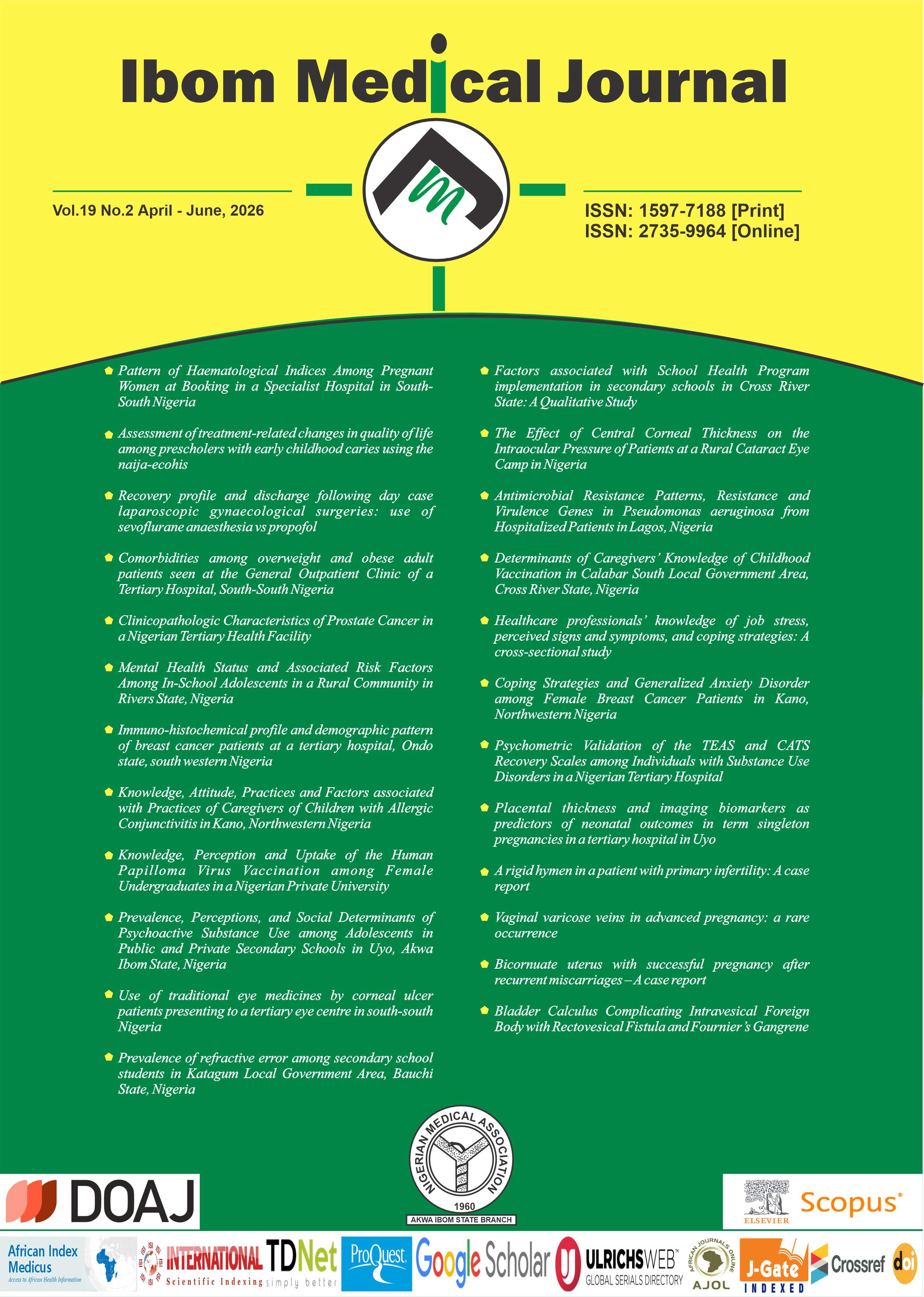
Recovery profile and discharge following day case laparoscopic gynaecological surgeries: use of sevoflurane anaesthesia vs propofol
DOI:
https://doi.org/10.61386/imj.v19i2.1054Keywords:
Day case, laparoscopic surgery, sevoflurane, propofolAbstract
Context: Rapid emergence and early recovery from anaesthesia with minimal complications are desirable. Both propofol and sevoflurane meet the above needs and are established as agents of choice in laparoscopic surgeries for induction and maintenance of anaesthesia. This study compared postoperative recovery and discharge profiles of sevoflurane with propofol in patients undergoing laparoscopic gynaecological surgeries under general anaesthesia.
Materials and Methods: In this prospective randomized clinical trial 60 patients, aged 18-65 years with ASA grade I and II scheduled for elective laparoscopic gynaecological surgeries under general anaesthesia were randomly allocated into two groups (Groups S and P, as sevoflurane and propofol groups respectively). Both groups were pre-treated with IV fentanyl 2μg/kg and then induced with IV propofol 2.5 mg/kg. In Group S, anaesthesia was maintained with sevoflurane inhalation 2.0 to 2.5% while in Group P, anaesthesia was maintained with propofol infusion (75-125 μg/kg/min), and 100% O2 at 4L/min.
Results: The age, weight and BMI between the two groups were comparable. The mean recovery time in group S was 6 minutes compared to 17 minutes in group P (p=0.007). The discharge time were also significantly in favour of group S which was 50 minutes compared to the 93 minutes of group P (p=0.001). The incidence of Post-operative nausea and vomiting (PONV), laryngospasm were comparable between the groups.
Conclusion: Sevoflurane is superior to propofol for maintenance of anaesthesia in day case laparoscopic gynaecological surgeries owing to its favourable recovery from anaesthesia and home readiness features. However, both groups were found to be comparable in terms of PONV, laryngospasm.
Downloads
Published
License
Copyright (c) 2026 Mohammed A, Ahmed AI, Salahu D, Abdurrahman A, Abdullahi MMM, Adesope S, Atiku M, Bello MR, Ibrahim N

This work is licensed under a Creative Commons Attribution 4.0 International License.