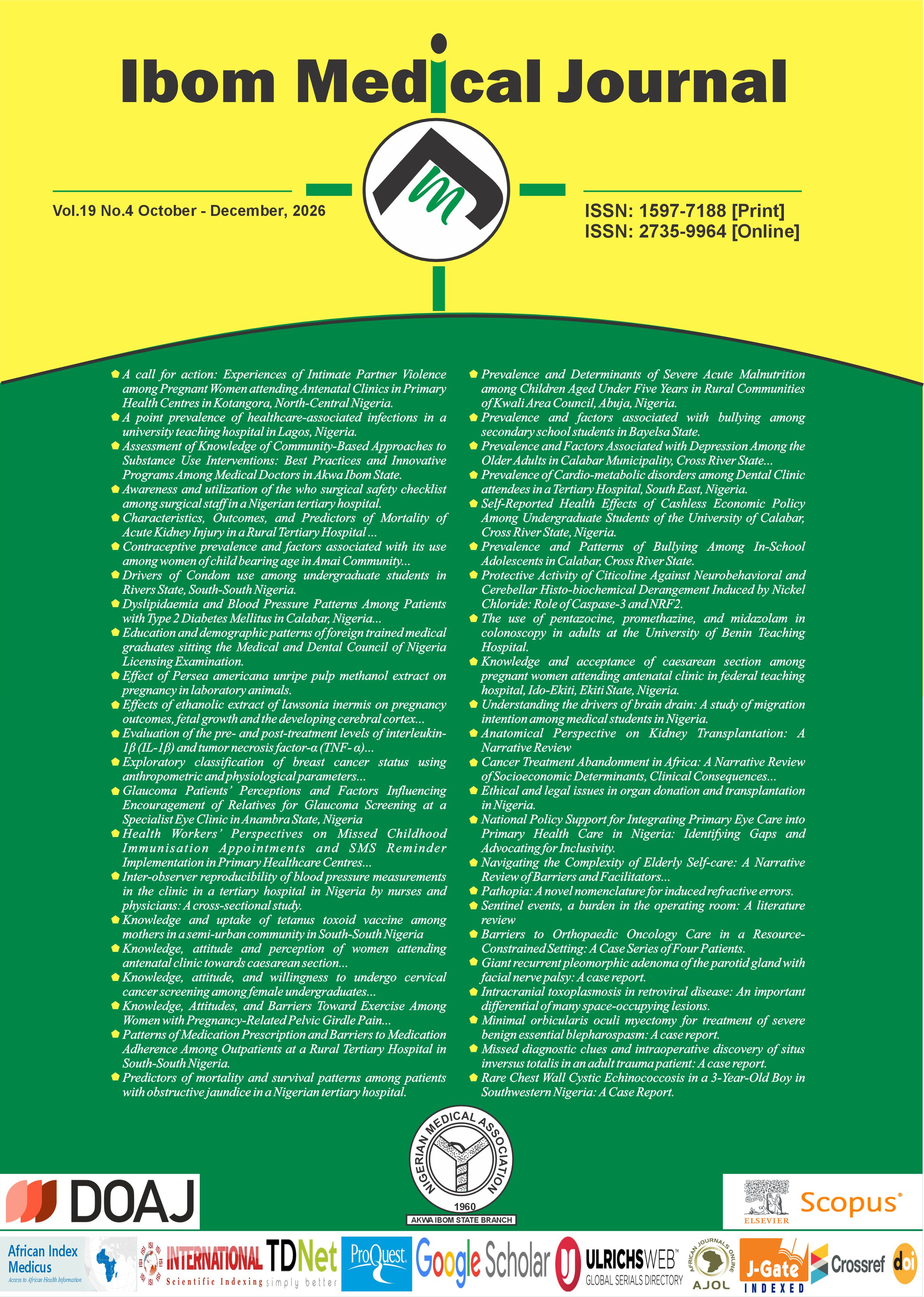
Knowledge, attitude and perception of women attending antenatal clinic towards caesarean section at a tertiary facility in south-south Nigeria
DOI:
https://doi.org/10.61386/imj.v19i4.1364Keywords:
Caesarean section, knowledge, attitude, perception, antenatal careAbstract
Context: Caesarean section (CS) is a life-saving obstetric procedure, yet its utilisation remains disproportionately low in sub-Saharan Africa, including Nigeria, where rates fall below the WHO-recommended minimum. Demand-side barriers rooted in inadequate knowledge, negative attitudes, and cultural misconceptions continue to drive this gap.
Objective: This study assessed the knowledge, attitudes, and perceptions of pregnant women attending antenatal care at a tertiary facility in South-South Nigeria towards caesarean sections.
Materials and Methods: A descriptive cross-sectional study was conducted among 290 consenting pregnant women attending the antenatal clinic of the Federal Medical Centre (FMC), Asaba, Delta State, between 1st March and 31st May 2024. Data were documented and analysed using SPSS version 26, and the level of significance was set at 5%.
Results: The mean age of respondents was 31.58±5.69 years. Good knowledge of CS was demonstrated by 150 (51.7%) of respondents, a positive attitude was reported by 275 (94.8%) of respondents, and good perception was held by 281 (96.9%) of study participants. Occupation (p = 0.004), parity (p < 0.001), and previous mode of delivery (p < 0.001) were significantly associated with a positive attitude towards CS.
Conclusion: Women attending antenatal care at FMC Asaba demonstrated predominantly good knowledge, positive attitude, and good perception towards caesarean section. Specific knowledge gaps and persistent cost perceptions remain addressable barriers. Occupation, parity and previous mode of delivery of the respondents were associated with a positive attitude towards caesarean section. Sustained evidence-based antenatal counselling on CS indications, safety, complications, and cost-mitigation pathways is recommended.
Downloads
Published
License
Copyright (c) 2026 Ilikannu SO, Onomuighokpo HO, Maduka NR, Jombo SE, Okoye NP, Ikpeze OZ, Ogwu RO, Ohachenu C, Obiegbu NP, Ilikannu CO, Uzoma CG, Auwal SS, Umenna CI, Ikonne UG, Osakwe CS

This work is licensed under a Creative Commons Attribution 4.0 International License.