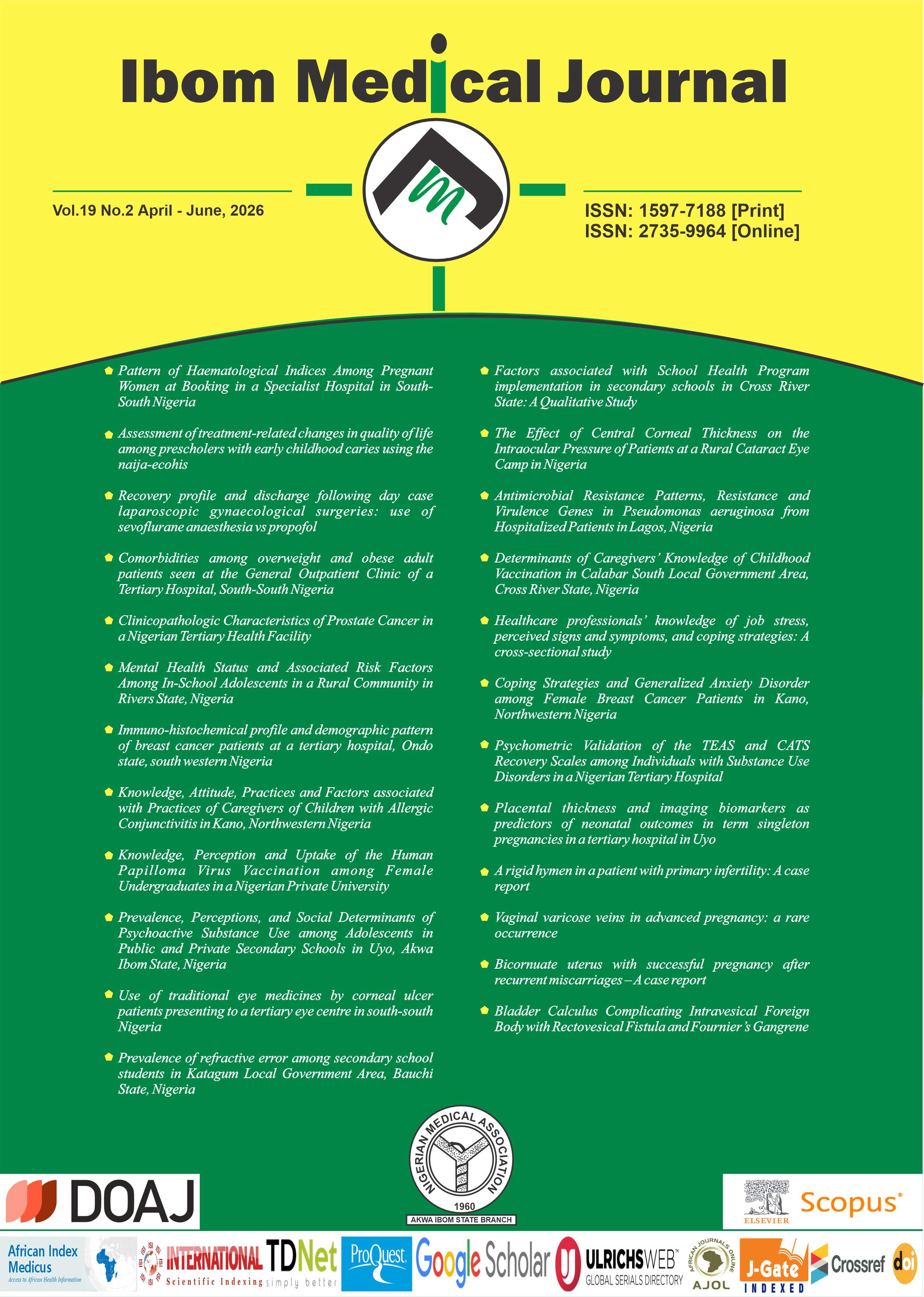
Mental Health Status and Associated Risk Factors Among In-School Adolescents in a Rural Community in Rivers State, Nigeria
DOI:
https://doi.org/10.61386/imj.v19i2.1061Keywords:
Mental Health, adolescents, psychological distress, GHQ 12, NigeriaAbstract
Context: Globally, the mental health of adolescents is a significant public health issue preventing many adolescents from reaching their full potential. Several socio-economic, cultural, and systemic factors make adolescents, especially in Nigeria, vulnerable.
Aim: The study was therefore conducted to assess the mental health status and identify risk factors of in-school adolescents in Community Secondary school Edagberi, Ahoada West, Rivers State, Nigeria.
Materials and Methods: A cross-sectional descriptive study among 231 in-school adolescents in Edagberi Better Land community of Rivers State was conducted. Community Secondary school Edagberi is one of the Renaissance Africa Energy Company, formerly Shell Petroleum Development Company supported schools with a recently commissioned Sick Bay and Water, Sanitation and Hygiene (WASH) facilities. A self-administered questionnaire including the General Health Questionnaire 12 (GHQ12) was used to elicit information from the respondents. Data were summarized using proportions, and X2 test was used to explore associations between categorical variables. Level of significance was set at p < 0.05.
Results: The mean age of the respondents was 14.4 ± 2.13 years, 58.4% were females, 55.0% were from junior class, and 78.8% resided with their parents. Based on the GHQ categorization, 69(29.9%) had traits of poor mental health status, compared to 70.1% with good mental health status. Some commonly reported stressors by the students were trekking long distances to school (54.1%), high transportation costs (51.9%) and family problems (49.9%). Predictors of poor mental health status in our study were low self-image /esteem (OR 2.19; 95% CI 1.16 -4.16) and polygamous family type (OR 1.95; 95% CI 1.24 -3.65) (p<0.05).
Conclusion: With a little over a quarter (29.9%) of adolescents with traits of poor mental health, provision of age-appropriate mental health services is strongly recommended to be incorporated in the school Health programme, particularly targeting students with low self-esteem and anxiety issues.
Downloads
Published
License
Copyright (c) 2026 Oku AO, Fajola A, Alali A, Obiagwu PN, Ogunlaja OA, Ebaretonbofa F, Utomi F, Adetula B, Gabriel O, Ejiogu M, Osuegbu O, Japhaet S, Ohio O

This work is licensed under a Creative Commons Attribution 4.0 International License.