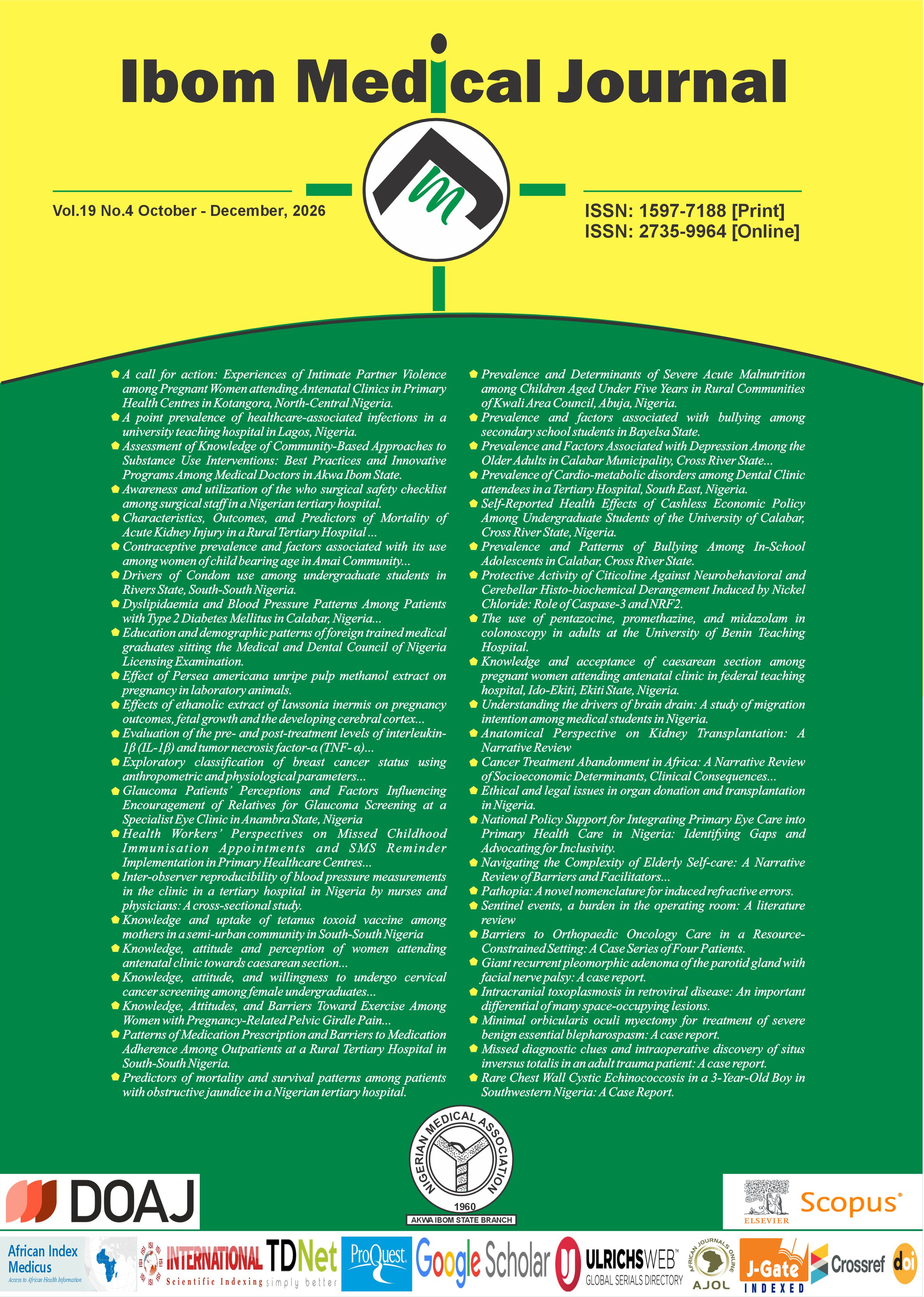
Prevalence and Determinants of Severe Acute Malnutrition among Children Aged Under Five Years in Rural Communities of Kwali Area Council, Abuja, Nigeria
DOI:
https://doi.org/10.61386/imj.v19i4.1370Keywords:
Severe Acute Malnutrition, Under-Five Children, Prevalence, Determinants, Water Source, Kwali, NigeriaAbstract
Context: Severe Acute Malnutrition (SAM) is a key public health problem in Nigeria, contributing to children's mortality. Understanding its local determinants is crucial for effective intervention.
Objective: This study aimed to determine the prevalence of SAM and to assess the effect of socio-economic, cultural/religious, and maternal/child-health-practice factors on SAM among children aged 6-59 months in the rural communities of Kwali Area Council, Abuja.
Materials and Methods: The study employed a community-based cross-sectional design involving 220 mother/caregiver-child pairs selected via a multi-stage sampling technique. Data were collected using structured questionnaires and anthropometric measurements. Nutritional status was determined using Mid-Upper Arm Circumference (MUAC), with SAM defined as MUAC < 11.5cm among children aged 6-59 months. Data were analysed in IBM SPSS Statistics version 29 using descriptive statistics, the Chi-square/Fisher's exact test for associations, and binary logistic regression done to identify independent determinants of SAM at a 5% significance level.
Results: The prevalence of SAM was 15.5% (34/220). At bivariate level, caregiver occupation (p=0.034), household drinking water source (p<0.001), food taboo (p=0.011), and immunization status (p=0.001) were significantly associated with SAM. Multivariable logistic regression (n=214) identified three significant independent determinants: food taboo (AOR=7.62, 95% CI: 1.86-31.17, p=0.005), incomplete immunization (AOR=4.92, 95% CI: 1.92-12.60, p=0.001), and an unimproved household drinking water source (AOR=4.06, 95% CI: 1.65-10.01, p=0.002).
Conclusion: The prevalence of SAM in Kwali (15.5%) remains above the national average of 7% and represents a serious public health concern. Food taboo practice, incomplete immunization, and an unimproved household drinking water source emerged as the three strongest, statistically significant, and modifiable determinants in this population, warranting targeted nutrition education, improved immunization coverage, and expansion of safe water access as priority interventions.
Downloads
Published
License
Copyright (c) 2026 Ngwu JC, Udeh SC, Okolo-Obasi NV, Anyanwu GO

This work is licensed under a Creative Commons Attribution 4.0 International License.