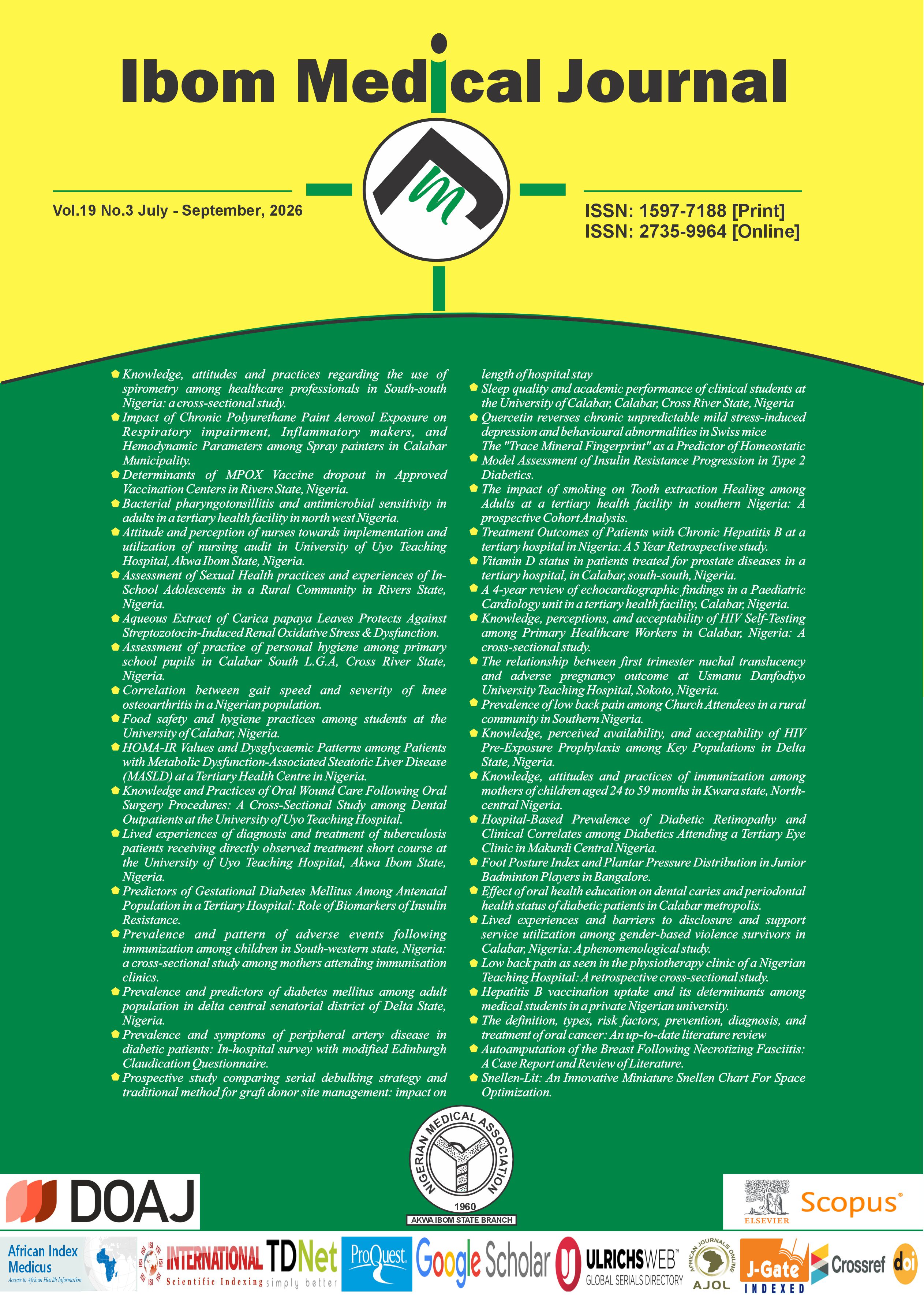
Treatment Outcomes of Patients with Chronic Hepatitis B at a tertiary hospital in Nigeria: A 5 Year Retrospective study
DOI:
https://doi.org/10.61386/imj.v19i3.1197Keywords:
Treatment outcomes, chronic hepatitis B, NigeriaAbstract
Context: Hepatitis B virus infection (HBV) is a global public health problem and a major cause of morbidity and mortality in Nigeria. This study determined the different treatment outcomes of patients with chronic hepatitis B virus infection and their associated factors in Nigeria.
Materials and Methods: This was a retrospective descriptive cross sectional study carried out at a tertiary hospital in Nigeria from January, 2018 to December 2022. The records of the adults diagnosed and managed for chronic HBV infection were retrieved. Data extracted included demographics, biochemical and hematological parameters, HBV panels and viral loads. These were analyzed using descriptive and inferential statistics.
Results: A total of 362 patients aged between 17 and 80 years, with a mean age (SD) of 42.4 (11.7) years were studied and 285(79.0%) were alive and in care. Majority of our patients achieved adequate virologic response 257(90.2%) and biochemical normalization 262 (92%). Virologic breakthrough was observed in 18(6.3%). Ten (3.5%) patients achieved HBsAg loss, which was more prevalent in patients treated with pegylated interferon plus nucleoside analogue (NA) therapy 5(50%) than those treated with nucleotide analogue only 3(30%). Poor drug adherence (86.7%), APRI Score ≥ 0.6 (66.7%), co-infections hepatitis C virus 9 (60%) and presence of diabetes mellitus (DM) (73.3%) were associated with poor treatment outcomes (P<0.005).
Conclusion: Adequate virologic response and biochemical normalization were the common treatment outcomes achieved in this cohort. HBsAg loss was achieved in few patients (higher with pegylated interferon plus NA therapy). Individuals with poor drug adherence, APRI Score≥ 0.6, Co-infection with HCV and DM need to be closely monitored to prevent virologic failure.
Downloads
Published
License
Copyright (c) 2026 Obasi E, Ajayi NA, Alo AT, Alo A, Ukwaja KN

This work is licensed under a Creative Commons Attribution 4.0 International License.